Design in Proteins
 The complex structure of the haemoglobin molecule |
Let us set aside “Where did the first cell come from?” and ask an easier question: “Where did the first protein come from?” Evolutionary theory has no answer to this either.Proteins are the cell’s building blocks. If a cell is a huge skyscraper, proteins are its bricks. Unlike bricks, however, they have no standard shape or structure. Even the simplest cells contain around 2,000 types of protein, whose extraordinarily harmonious cooperation keeps the cell alive.
Proteins consist of smaller structures, molecules called “amino acids”, formed from different combinations of carbon, nitrogen and hydrogen atoms. An average protein contains between 500 and 1,000 amino acids; some are much larger.
Architecture in Proteins
 Proteins have sophisticated designs and help build our bodies. Indeed, we are largely composed of them: they are the basic material of our bones, eyes, hair and muscles. Here you see the complex internal organisation of a single fibre in one of our muscles. Cells containing different combinations of proteins form every detail visible in this structure. Each detail is perfectly designed and built from an organic material: protein. This fascinating architecture is among the most striking signs of creation. |
The crucial point is that amino acids must line up in a specific order to form a protein. Living organisms use twenty types of amino acid. These do not combine randomly to produce proteins: each protein has a particular sequence, which must be assembled precisely. Even one missing or substituted amino acid turns it into a useless molecular mass. Every amino acid must therefore occupy the right place in the correct order. Instructions for this sequence are stored in the cell’s DNA and used to manufacture proteins.Evolutionary theory asserts that the first protein formed “by chance”. Yet probability calculations show this to be impossible. For example, the probability of the amino acids in a protein of 500 amino acids being correctly ordered is 1 in 10^950.(See Harun Yahya, Le Mensonge de l’évolution, Éditions Essalam, 1999, pp. 141–142.)10^950 is an unimaginable number: 1 followed by 950 zeros. In mathematics, a probability below 1 in 10^50 is regarded as virtually impossible.
|
Protein Synthesis
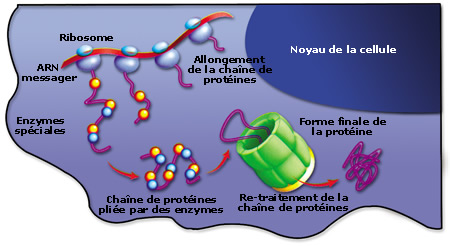
Activity takes place constantly inside our cells. Proteins in the food we eat are broken down, and their components, amino acids, are recombined according to DNA’s codes. This produces the new proteins the body needs. Called “protein synthesis”, the process is far more complex than this simplified illustration. No laboratory can synthesise proteins as effectively as a cell. |
|
In short, not even one protein can form by chance. Evolutionists sometimes admit this. The well-known evolutionary scientist Harold Blum, for example, states that “the spontaneous formation of a polypeptide the size of the smallest known protein appears beyond all probability”.W. R. Bird, The Origin of Species Revisited, Nashville: Thomas Nelson Co., 1991, p. 304.What does this mean? Chemistry professor Perry Reeves answers:“Considering the vast number of structures that could result from amino acids combining randomly in an evaporating primordial pond, it strains belief that life arose this way. A master builder with a blueprint and an overall strategy is a more plausible requirement for such a task.”J. D. Thomas, Evolution and Faith, Abilene, TX: ACU Press, 1988, pp. 81–82.
|
|
Can Monkeys Write a Book?
Cytochrome c is the scientific name of one of the most important proteins enabling oxygen-based respiration, making it vital to survival. Its extraordinarily complex design cannot form by chance. Professor Ali Demirsoy, a prominent defender of evolution in Turkey, states in Heredity and Evolution that its chance formation is “as unlikely as a monkey typing the history of humanity without making a mistake”. Ali Demirsoy, Kalıtım ve Evrim (Heredity and Evolution), Ankara: Meteksan Yayınları, 1984, p. 64.
|
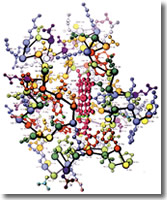 The cytochrome c protein |
|



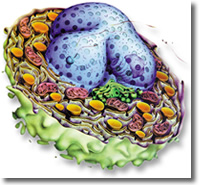 All living creatures consist of cells. Even a single cell is self-sufficient: it can produce its own food, move and communicate with other cells. Its extraordinary technology provides concrete evidence that life did not originate by chance.
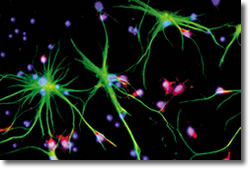 The Complexity of Brain Cells
The brain has more than 10,000 cells constantly interacting with one another. This communication network is far more complex than all the world’s switching centres.
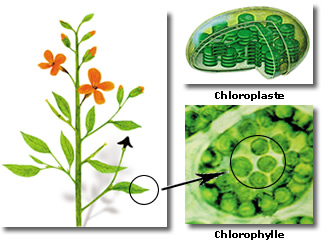

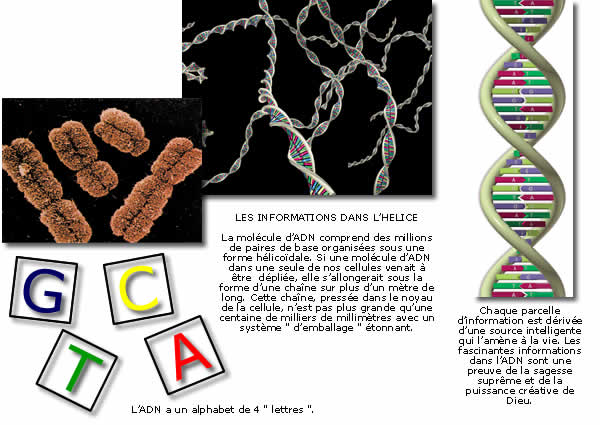
 Did you know that the nucleus of each of the trillions of cells in a human being contains a database large enough to fill a 900-volume encyclopaedia?
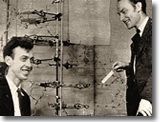 Francis Crick and James Watson discovered DNA’s structure. Although an evolutionist, Crick stated that DNA could never have formed purely by chance.