The myth of evolution

Refuting the Proposed Mechanisms of Evolution

Can natural selection and mutations produce new species? Explore the article’s objections, from industrial melanism to genetic information.

Refuting the Proposed Mechanisms of Evolution

The Natural Selection Misconception
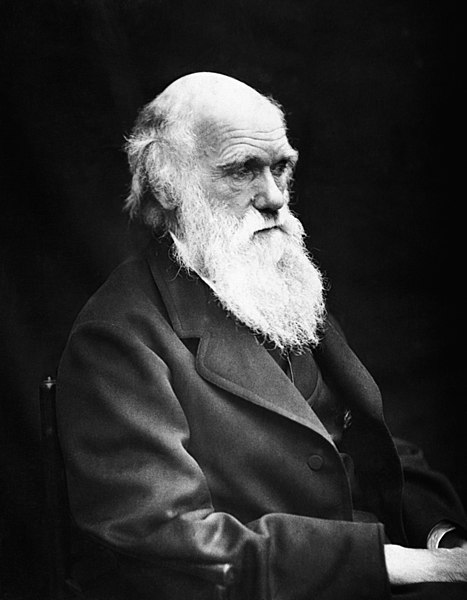
Darwin’s book: On the Origin of Species by Means of Natural Selection… Natural selection, which Darwin proposed as an evolutionary mechanism, has no evolutionary power. It cannot produce new species.Just as life cannot arise on earth by chance, species cannot turn into other species: no such power exists in nature. What we call nature is the sum of unconscious atoms composing soil, rocks, air, water and everything else. This collection of lifeless matter cannot turn an invertebrate into a fish, bring it onto land, transform it into a reptile, then a bird capable of flight, and finally a human being.

Lamarck’s Hypothesis

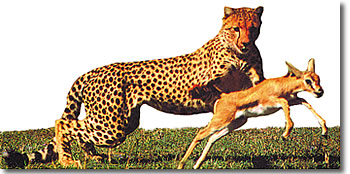
When Darwin suggested that “natural selection causes species to evolve”, he drew inspiration from Lamarck’s hypothesis of “the inheritance of acquired characteristics”. Lamarck held that giraffes’ necks lengthened as they tried to reach high branches for food. Twentieth-century science, however, proved Lamarckism wrong. In arguing otherwise, Darwin relied on a single “evolutionary mechanism”: natural selection. This rests on the idea that the strongest creatures, best adapted to their habitats, survive. In a herd of deer threatened by wild predators, for example, the fastest runners survive. Yet this would not make deer evolve or turn them into other creatures, such as elephants. There is not the slightest empirical evidence that natural selection has ever caused living creatures to evolve. The prominent British evolutionary palaeontologist Colin Patterson admits:“No one has ever produced a species through natural selection. No one has even come close, and most current arguments within neo-Darwinism concern this question.” (Colin Patterson, “Cladistics”, BBC interview with Brian Leek and Peter Franz, 4 March 1982.)

Selection Cannot Produce New Species

In nature, weaker individuals are eliminated and replaced by stronger ones. Yet this does not produce new species. Even if predators hunted weak, slow deer for billions of years, deer would not become a different species. The Story of Industrial Melanism


Dark and coloured moths existed both before and after the Industrial Revolution. No new moth species emerged.


This moth collection shows that black and coloured moths lived in the region before the revolution. Evolutionists commonly cite the moths of eighteenth-century industrial England as an “observed example of evolution through natural selection”. They explain that tree bark around Manchester was initially light-coloured, making black moths easy prey for birds and threatening their extinction. Industrial pollution then darkened the bark, making light-coloured moths the easy prey instead, while black moth numbers rose. Yet this is not “evolution”: natural selection produced no previously non-existent species. Black moths existed well before industrialisation. Here we see specimens collected before and after the Industrial Revolution. Only the numbers of existing species changed. The moths acquired no new organ and underwent no transformation into a different species.

Self-Sacrifice in Animals

Darwin’s theory of evolution through natural selection assumed that all living creatures fight a fierce battle for survival. Observations, however, show remarkable sacrifice and cooperation among animals. Wild cattle forming a protective circle around their young provide just one example of self-sacrifice in nature.

Mutations


The Effects of Chernobyl

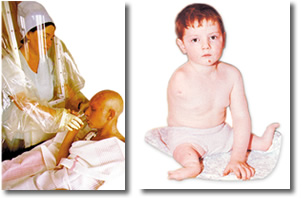
Radioactivity is the principal cause of mutations in humans, and mutations are always harmful. Those affected by mutations after the Chernobyl disaster suffered either fatal cancers or malformed organs, as shown here.Mutations are genetic accidents in living creatures. Like all accidents, they are harmful and destructive. “Evolution” through mutation is as improbable as improving a watch by striking it with a hammer.Realising that natural selection had no evolutionary function, evolutionists added “mutation” to their claims in the 20th century. Mutations are distortions in organisms’ genes caused by external influences such as radiation. Evolutionists claim these accidents make organisms evolve. Scientific findings reject this, since all observable mutations harm living creatures. All human mutations cause mental or physical abnormalities, such as Down syndrome, albinism and dwarfism, or diseases such as cancer.
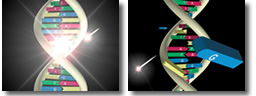

Distortion of DNA

The DNA code determines living creatures’ physical traits. If an external influence such as radiation shifts or rearranges this code, a mutation occurs. Another reason mutations cannot cause evolution is that these accidents add no new genetic information. They reshuffle existing information randomly, like a deck of cards. No new genetic information is introduced. De Vries’s Error
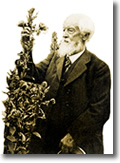
The Dutch botanist Hugo de Vries, who discovered mutation, thought he had found an “evolutionary mechanism”. Years of experiments and observations, however, showed mutations to be merely “mechanisms of distortion”. Evolutionary theory nevertheless claims that living creatures’ genetic information increases over time. A simple bacterium, for example, contains 2,000 protein types, whereas a human organism contains 100,000. For a bacterium to evolve into a human, exactly 98,000 new proteins would have to arise. Mutations cannot produce these structures, because they cannot add anything to the DNA chain. Unsurprisingly, no mutation has yet been observed to increase a life form’s genetic information. Although himself an evolutionist, Pierre-Paul Grassé, former president of the French Academy of Sciences, admitted:“However numerous they may be, mutations produce no kind of evolution.”(Pierre-Paul Grassé, Evolution of Living Organisms, New York: Academic Press, 1977, p. 88.) 
Twin Mutations

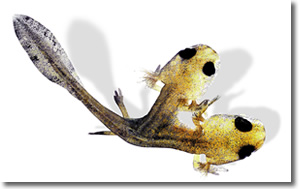
The disorder producing conjoined twins in humans is caused by mutations. These frogs, joined together at birth, illustrate the results of mutation.
 

Fruit Fly Experiments

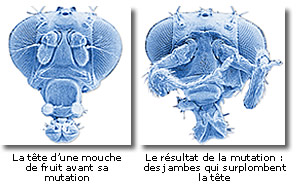
For decades, evolutionists carried out mutation experiments on fruit flies because they reproduce quickly and are easy to mutate. These creatures were subjected to millions of mutations in every possible way. Yet not a single beneficial mutation was observed.