The myth of evolution

Fabrications and Misleading Interpretations of Facts

Does Miller’s experiment explain life’s origins? Explore the article’s critique of the experiment and of claims about coelacanths and Archaeopteryx.

Fabrications and Misleading Interpretations of Facts
 

The Miller Experiment


Miller with his experimental apparatus
Evolutionists sometimes cite Miller’s experiment as evidence that life formed by chance under primordial earthly conditions. Yet subsequent discoveries stripped this experiment, conducted some fifty years ago, of its scientific significance.


In 1953, the American chemist Stanley Miller conducted an experiment to support molecular evolution. He assumed the early earth’s atmosphere consisted of methane, ammonia and hydrogen. He combined these gases in an experimental apparatus and passed electricity through the mixture. Almost a month later, he observed that some amino acids had formed.

The Misconception about the Primordial Atmosphere

Miller claimed that his experiment precisely reproduced the primordial atmosphere. Yet the gases he used did not even remotely resemble actual early-earth conditions. Moreover, mechanisms deliberately introduced by Miller interfered with the experiment. In fact, he inadvertently refuted the evolutionists’ claim that amino acids could form spontaneously under natural conditions.
The discovery generated great enthusiasm among evolutionists. Over the following twenty years, researchers such as Sidney Fox and Cyril Ponnamperuma tried to develop Miller’s scenario.

Discoveries in the 1970s refuted these attempts, known as “primordial atmosphere experiments”. The methane-ammonia model Miller proposed and other evolutionists accepted proved entirely false. Miller deliberately chose gases favourable to amino-acid formation. Scientific discoveries instead showed that the primordial atmosphere consisted of nitrogen, carbon dioxide and water vapour.J. P. Ferris and C. T. Chen, “Photochemistry of Methane, Nitrogen, and Water Mixture As a Model for the Atmosphere of the Primitive Earth”, Journal of the American Chemical Society, vol. 97, no. 11, 1975, p. 2964.
This atmospheric model was entirely unsuitable for amino-acid formation. Furthermore, it was established that large quantities of oxygen arose naturally in the primordial atmosphere.“New Evidence on Evolution of Early Atmosphere and Life”, Bulletin of the American Meteorological Society, vol. 63, November 1982, pp. 1328–1330.This also refutes the evolutionists’ scenario, because free oxygen would break down amino acids.


Miller’s Assumptions The Actual Conditions Why Is This Experiment Invalid?
He used methane, ammonia and water vapour in the experiment.  The early earth contained carbon dioxide and nitrogen rather than methane and ammonia.

The American researchers Ferris and Chen repeated the experiment using the gases present in the primordial atmosphere. No amino acids were obtained.

He assumed there was no oxygen in the early atmosphere. Discoveries show that the early atmosphere contained very large quantities of free oxygen. With so much oxygen present, even in the highly unlikely event that amino acids formed, they would eventually break down.
He installed a special mechanism to synthesise amino acids. This “cold trap” removed them from the environment as soon as they formed, preserving them. Such a mechanism could not arise spontaneously in nature. Under natural conditions, amino acids are exposed to numerous destructive external influences. Without the cold trap, the spark source and other chemicals released during the experiment would have destroyed the amino acids.

Fox’s Unsuccessful Experiment

Inspired by Miller’s scenario, evolutionists conducted various experiments in later years. By combining amino acids, Sidney Fox produced the molecules shown here, which he called “proteinoids”. These useless amino-acid chains bore no relation to the real proteins composing living creatures’ bodies. These efforts demonstrated not only that life did not arise through mere coincidences, but also that it could not be reproduced under laboratory conditions.
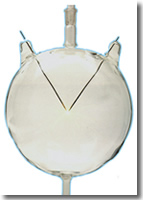
In light of these discoveries, the scientific community acknowledged in the 1980s that Miller’s experiment and subsequent “primordial atmosphere experiments” were meaningless. After a long silence, Miller also admitted that the atmosphere he used was unrealistic.“Life’s Crucible”, Earth, February 1998, p. 34.


It should also be emphasised that all this excitement concerned only the formation of amino acids. These basic organic molecules cannot randomly give rise to extremely complex structures such as proteins and produce a living cell, which even humanity cannot reproduce in modern laboratories.

The fifty years since Miller’s experiment have only made evolutionary theory’s disappointment at the molecular level more apparent.

Miller’s Admission

Today, Miller too has accepted that his 1953 experiment came nowhere near explaining life’s origins.


The Coelacanth Misconception


The End of the Myth

The coelacanth is alive! The team that caught the first living specimen in the Indian Ocean on 22 December 1938 poses with the fish.

Until seventy years ago, evolutionists had a fish fossil they considered “the ancestor of land animals”. Scientific advances, however, ended all their claims about this fish.

Today, evolutionists have also come to acknowledge the absence of transitional fossils between fish and amphibians. Yet only seventy years ago, a fossil fish called the coelacanth was regarded as a complete intermediate form. Evolution’s proponents claimed that this fish, estimated at 410 million years old, possessed a primitive lung, a developed brain, digestive and circulatory systems ready for terrestrial life, and even a primitive walking mechanism. Scientific circles accepted these interpretations as indisputable truth until the late 1930s.

On 22 December 1938, however, a remarkable Indian Ocean discovery refuted what had been treated as scientific fact: a living coelacanth was caught, although this supposed transitional form had allegedly disappeared seventy million years earlier! Finding a living specimen dealt evolutionists a severe blow, collapsing their claims. Evolutionary palaeontologist J. L. B. Smith said he could not have been more surprised had he encountered a living dinosaur.(Jean-Jacques Hublin, The Hamlyn Encyclopaedia of Prehistoric Animals, New York: The Hamlyn Publishing Group Ltd., 1984, p. 120.)In subsequent years, more than two hundred coelacanths were caught in different parts of the world.


Imaginary Drawings and a Real Coelacanth

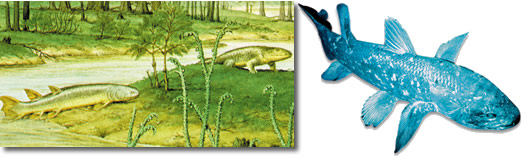
Before a living specimen was found, evolutionists presented the coelacanth as the ancestor of “all land animals”. Drawings such as those above were presented as reality and entered scientific books. When a living fish was caught, as shown alongside, all these evolutionary claims were discredited.

Living coelacanths revealed how far evolutionists would go in constructing imaginary scenarios. Contrary to their claims, the fish had neither a primitive lung nor a large brain. The organ described as a primitive lung proved to be merely a fat-filled sac.(Jacques Millot, “The Coelacanth”, Scientific American, vol. 193, December 1955, p. 39.)

Furthermore, the coelacanth presented as a “prospective reptile preparing to move from sea to land” was actually a deep-water fish that always remained more than 180 metres below the surface. (Bilim ve Teknik [Science and Technology], November 1998, no. 372, p. 21.)

The Difference between Fins and Legs


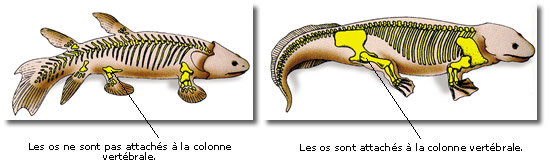
Evolutionists imagined the coelacanth and similar fish to be “ancestors of land animals” because of their bony fins. They suppose these bones gradually became legs. Yet there is a fundamental difference: as shown above, these fish’s fin bones are not attached to the backbone, whereas land animals’ limb bones attach directly to it, as shown below. The claim that these fins gradually became legs therefore has no basis.


The Archaeopteryx Misconception


A reconstruction of Archaeopteryx

The Archaeopteryx fossil is the only evidence evolutionists have found to support the claim that “birds evolved from dinosaurs”. Recent discoveries, however, show that it was simply an extinct bird species.

The principal candidate for an intermediate form cited by evolutionists is Archaeopteryx, a bird fossil 150 million years old. They claim it was half dinosaur and could not fly properly.


Evolutionists’ Tales
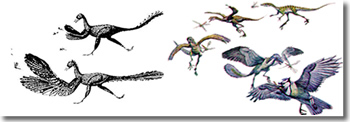
Taking advantage of public trust in scientists, evolutionists have sometimes claimed that “small dinosaurs acquired wings and became birds”. Their explanation of this transformation is a fairy tale. As their drawings illustrate, they say that dinosaurs waving their forelimbs to chase flies gradually “grew wings”. This imaginary scenario raises an interesting question: how did the flies acquire wings? They not only flew, but displayed wonderful aerodynamics, beating their wings synchronously five hundred times a second.

This evolutionary claim, repeatedly shown false, finally collapsed with an Archaeopteryx fossil unearthed in 1992.

The supposed absence of a sternum, the breastbone essential for flight muscles, was regarded as the strongest evidence that this bird could not fly properly. The seventh Archaeopteryx fossil, unearthed in 1992, revealed that this bone, long claimed to be absent, actually existed. Its presence proved that Archaeopteryx was a flying bird.(Nature, vol. 382, 1 August 1996, p. 401.)

Two other features cited as evidence of an intermediate form—wing claws and teeth—have also been shown to imply no such thing. Two living birds, the turaco and hoatzin, have wing claws used to grip branches. Various bird species in the past also had teeth. Furthermore, measurements by prominent ornithologists such as Martin, Stewart and Whetstone showed that Archaeopteryx’s tooth structure differed completely from that of reptiles.(L. D. Martin, J. D. Stewart and K. N. Whetstone, The Auk, vol. 98, 1980, p. 86.)These discoveries show that evolutionary claims presenting Archaeopteryx as an intermediate form have no scientific basis.

A fossil of Confuciusornis and an illustration of the bird

Other Toothless Beaks
Confuciusornis, whose fossil is shown here, lived in the same geological period as Archaeopteryx. Unlike it, however, its beak contained no teeth. This discovery showed that Archaeopteryx was not “primitive”, but a distinctive bird species.
Feathers and Scales
Evolutionary theory must propose that feathers, perfectly designed for flight, evolved from reptile scales. Yet feathers and scales differ completely in genetic origin and embryological development. Above is the detailed structure of a bird’s feather; alongside are a reptile’s scales.
Hoatzin

The Hoatzin’s Claws
Some living bird species have features similar to Archaeopteryx’s. The hoatzin, for example, also has claw-like structures on its wings.